Patient Resources

Tibiofemoral Joint Exam

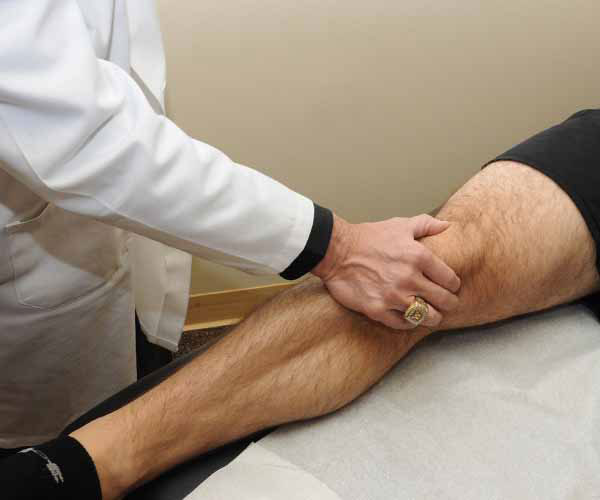
Tibiofemoral instability is usually due to an acute or chronic injury of the ACL, PCL, medial knee structures or posterolateral complex of the knee. True tibiofemoral joint instability results in the knee subluxing, sliding front to back or having a side-to-side instability, with activities. These activities can include twisting, turning, pivoting or other activities.

It is […]
Tibiofemoral Joint Exam

Assessement of Tibiofemoral Joint

Examination of the tibiofemoral joint should be performed in a stepwise manner. In general, one performs stability testing for anterior translation, posterior translation, medial sided injuries, and posterolateral injuries in a uniform and stepwise manner to determine if there are any associated instabilities. It is important when performing this testing to compare any motion increases […]

Assessement of Tibiofemoral Joint

Suprapatella Plica Palpatation

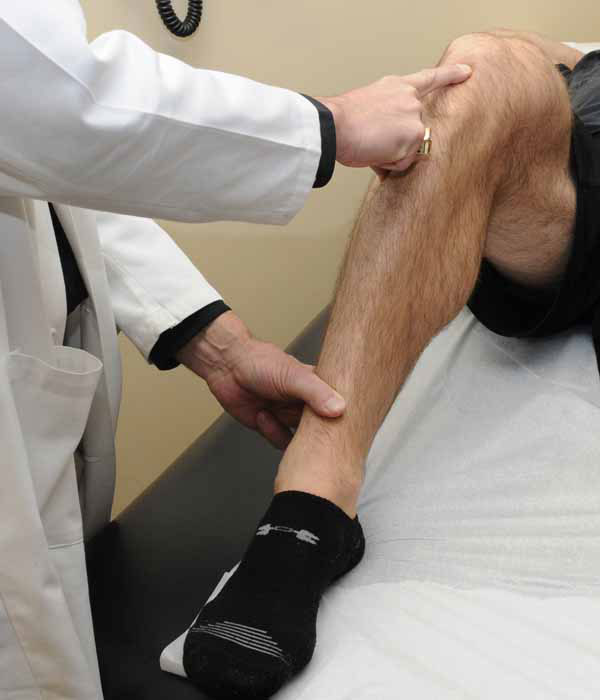
The medial suprapatella plica is a common source of knee pain. It is a normal fold of the joint lining which can become irritated when there are other pathologies of the knee or it can become fibrotic after injury or surgery. Thus, assessment of this as a source of pain is helpful to […]

Suprapatella Plica Palpatation

Thigh Circumference Measurement

(Click to Enlarge)

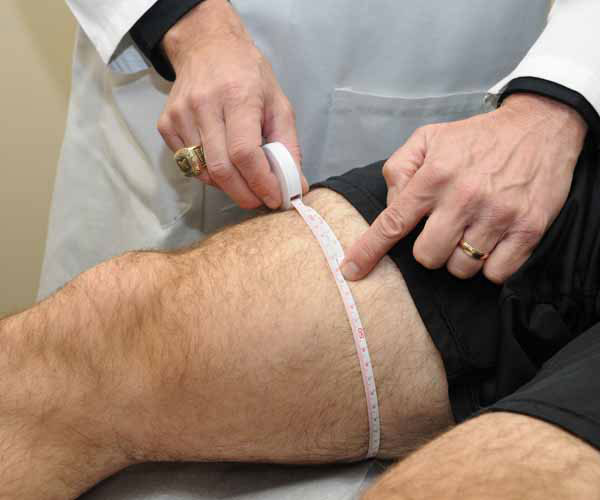
In general, the amount of quadriceps atrophy that is present in one’s thigh is indicative of the amount of weakness present. In our experience, about 2 cm of quadriceps atrophy can be equivalent to about 70% of the strength […]

Thigh Circumference Measurement

Hamstring Tightness Assessment

In patients who have irritation of the bursa around the knee with patellofemoral pain, it is important to determine the amount of relative hamstring tightness. To assess this, we determine the “hamstring-popliteal angle”. In this test, the hip is flexed to 90° and it is important to relax the knee completely. The knee […]

Hamstring Tightness Assessment

Lateral Patellar Apprehension Test

(Click to Enlarge Image)

In most cases with patellar dislocations, the patellar dislocates laterally. This results in stretching of the medial tissues and can result in continued instability, especially in patients who have trochlear dysplasia. While most patients with first time patellar […]

Lateral Patellar Apprehension Test

Medial Patellar Apprehension Test

In general, patients do not have problems with medial patellar instability. However, in some patients who have had a lateral release, they will have symptoms of the patella subluxing medially. This can occur in patients with an extensive lateral release.

This can be one of the most difficult problems to diagnose in orthopaedics because it is […]

Medial Patellar Apprehension Test

Examination of the Patellofemoral Joint

(Click to Enlarge Image)

(Click to Enlarge Image)

The patellofemoral joint is a very common source of knee pain. It can be a primary source or it can also be due to […]

Examination of the Patellofemoral Joint

Patellofemoral Joint Pain

One of the most common causes of knee pain is irritation of the patellofemoral joint. Almost all the structures around the patellofemoral joint can be palpated to help one localize best the area of the patient’s pain.

The medial suprapatellar plica is palpated by rolling ones finger along the edge of the medial femoral condyle between […]

Patellofemoral Joint Pain

Assessment for Meniscal Tears

Medial Meniscus

Lateral Meniscus

(Click to Enlarge)

The meniscus is an important shock absorber of the joint. As one ages, the meniscus can become more brittle and is much easier to tear. An arthroscopic meniscectomy is performed in over 200,000 – 300,000 patients […]

Assessment for Meniscal Tears
Go to Top