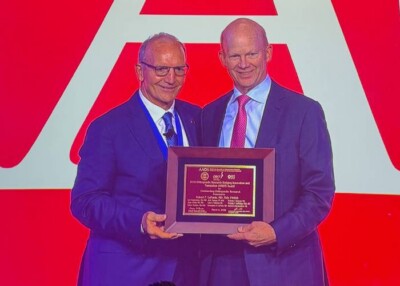
Dr. Robert F. LaPrade Receives Prestigious ORBIT Award for Two Decades of Groundbreaking Research Advancing PCL Injury Care
Robert F. LaPrade, MD, PhD, FAAOS has been honored with the 2026 Orthopaedic Research Bridging Innovation and Translation (ORBIT) Award in recognition of more than 20 years of pioneering research dedicated to improving the diagnosis, surgical treatment, and rehabilitation of posterior cruciate ligament (PCL) injuries. The award recognizes Dr. LaPrade and his research team’s extensive scientific contributions, which include 34 peer-reviewed publications, five invited journal articles, and 14 book chapters focused on PCL reconstruction and knee ligament science.
Transforming the Understanding of PCL Injuries:
PCL injuries (often caused by dashboard impacts in car accidents, falls onto a bent knee, or hyperextension trauma) can significantly alter knee mechanics. Untreated PCL deficiency can lead to abnormal joint motion and increased pressure in key compartments of the knee, raising the risk of symptomatic arthritis and, in some cases, eventual knee replacement.
“Approximately 24 years ago, outcomes after PCL reconstruction were often fair to poor because of graft stretching and residual looseness,” said Dr. LaPrade. “At the time, some even questioned whether reconstruction should be performed at all. We recognized early on that improving diagnosis, surgical precision, and rehabilitation strategies would be essential to truly help patients.”
A Research Pyramid That Changed Clinical Practice:
Over two decades, Dr. LaPrade’s team used a systematic bench-to-bedside research model to close knowledge gaps and refine patient care. Their work established measurable surgical landmarks, clarified PCL biomechanics, standardized diagnostic imaging protocols, and developed anatomically accurate reconstruction techniques paired with optimized rehabilitation methods.
One of the group’s major breakthroughs was identifying consistent bony landmarks that guide surgeons in accurately positioning grafts during reconstruction. These discoveries helped improve tunnel placement in advanced double-bundle PCL reconstruction techniques, which more closely restore natural knee motion.
Redefining Knee Stability Science:
Historically, surgeons believed one portion of the PCL, the anterolateral bundle, was primarily responsible for stability. Through robotic testing, biomechanical analysis, and clinical studies, Dr. LaPrade’s research demonstrated that the PCL’s two bundles function together. Their findings showed that reconstructing both bundles can better reproduce normal knee kinematics and stability.
“We found the bundles work in a codominant relationship,” Dr. LaPrade explained. “Understanding that interaction has been critical for improving surgical outcomes and restoring knee function.”
His team also helped establish objective diagnostic standards using stress radiographs and MRI imaging, allowing clinicians to detect functional ligament deficiency even when the ligament appears intact on routine imaging.
Advancing Rehabilitation and Non-Surgical Healing:
Beyond surgery, Dr. LaPrade’s research reshaped rehabilitation principles for PCL injuries. By recognizing how gravity affects ligament healing, his team introduced prone-position exercises that protect the ligament during recovery. They also collaborated in developing a dynamic PCL brace that applies forward pressure to the tibia, mimicking natural ligament support. In some patients, this innovation has enabled healing without surgery.
Today, outcomes for isolated PCL reconstruction can approach those seen with ACL reconstruction, an achievement many once considered unlikely. Ongoing research is now evaluating earlier weight-bearing strategies and their impact on recovery timelines.
A Global Impact on Knee Ligament Care:
The ORBIT Award highlights not only the depth of Dr. LaPrade’s research but also its real-world impact on patient care worldwide. His work has influenced surgical education, clinical guidelines, and treatment standards for complex knee ligament injuries.