Patient Resources

Tibiofemoral Joint Line Pain

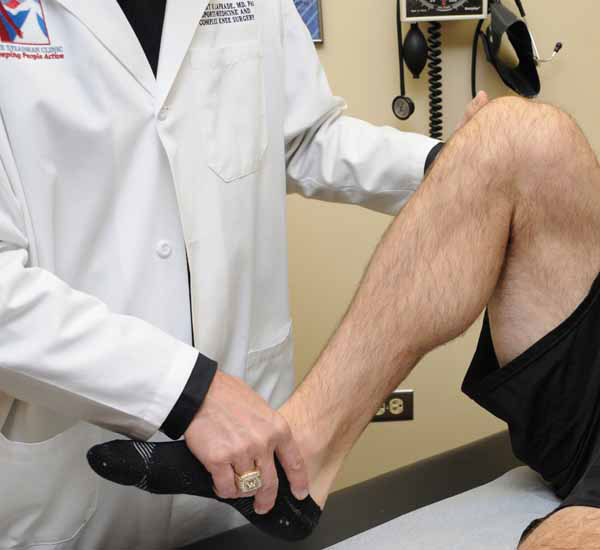
Pain along the medial or lateral joint lines may be indicative of a joint capsule tear, joint capsule irritation, meniscus tear, chondromalacia, osteochonritis dissecans, arthritis or other joint pathologies. Palpation of the joint line while performing a valgus or varus stress test will help to differentiate the area of the pain. It is also important […]
Tibiofemoral Joint Line Pain

Posterior Knee Pain with Flexion

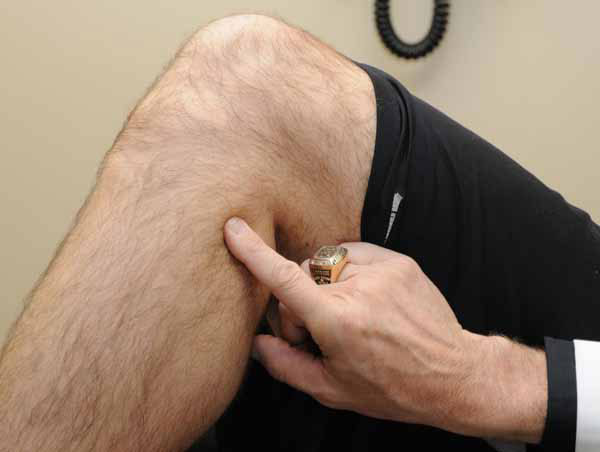
One of the most common ways to determine a symptomatic meniscus tear is to have the patient perform a deep squat or flex their knee into maximal flexion. Pain in the back of the knee is a meniscus tear until proven otherwise. Other sources of pain can include a Baker’s cyst, cruciate ligament ganglion cyst, […]

Posterior Knee Pain with Flexion

Evaluation of the Patellofemoral Joint – Anterior Knee Pain

The term “anterior knee pain” is a generic description for various types of pain involving the patellofemoral joint. Similar to the use of the term chondromalacia patella, it is a relatively generic term which does not give any specifics about the anatomic structures involved with a particular joint pathology.

Many causes of anterior knee pain are […]

Evaluation of the Patellofemoral Joint – Anterior Knee Pain

Range of Motion – Flexion

(click to enlarge)

Knee flexion is assessed by maximally flexing the knee as far posteriorly as possible. In the face of an acute injury or for patients who have pain from swelling, full flexion may not be assessable because of too much […]

Range of Motion – Flexion

Range of Motion – Extension

(click to enlarge)

One of the first assessments we do in the evaluation of a patient is to assess their amount of hyperextension. It is important to have the patient relaxed while performing this assessment. In general, we lift the ankle or […]

Range of Motion – Extension

Assessment of Knee Range of Motion

It is very important to assess a patient’s knee range of motion to determine if there is any mechanical block, lack of motion due to arthritis or previous surgery, or increased motion due to a ligament injury. While doing this, it is ideal to compare it to a patient’s normal contralateral knee. Limitation of knee […]

Assessment of Knee Range of Motion

Palpation of a Joint

Common Peroneal Nerve Palpation (click to enlarge)

One of the key points of a physical exam is to determine the exact location of a patient’s pain so one can correlate it to the history and specific anatomic parts. This helps to localize […]

Palpation of a Joint

Inspection

One of the first things a physician does is to inspect the knee. Abrasions, lacerations, previous scars, swelling or prominences are important to evaluate. Swelling around the knee can be either due to causes outside the knee (extraarticular) or causes from inside the knee (intraarticular). In most circumstances, a physical exam can determine whether the swelling […]

Inspection

Clinical Exam

HISTORY

It is very important to understand a patient’s history prior to performing a clinical exam. In fact, it is generally felt approximately 85% of the time that one can arrive at a working diagnosis for a knee pathology based on the history alone. The physical exam can then be more focused to confirm or […]

Clinical Exam
Go to Top