


Description of Posterior Horn Medial Meniscus Tear
The posterior horn of the medial meniscus is that portion of the medial meniscus in the back part of the knee. It varies from the main weightbearing portion of the meniscus up to where it attaches on the tibia at its lateral aspect, called the root attachment.
The posterior horn of the medial meniscus is the most important weightbearing portion of the meniscus. While the medial meniscus absorbs 50% of the weight transmitted across the medial compartment, the posterior horn of the medial meniscus is the most important portion of the meniscus that provides the shock absorbing capacity.
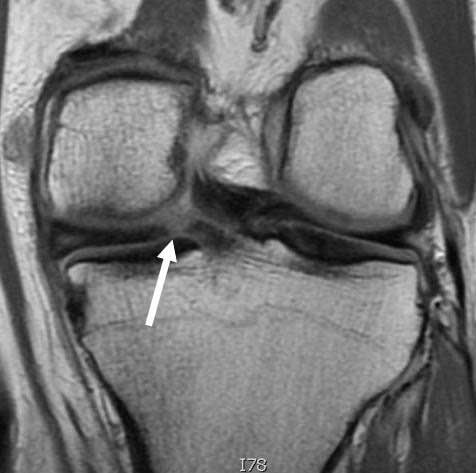
Coronal view MRI scan demonstrating a posterior horn medial meniscus root tear. The meniscus is torn off its attachment site and tends to sublux posteromedially. This meniscal extrusion can lead to a nonfunctional medial meniscus and the early development of osteoarthritis.
CLICK IMAGE TO ENLARGE
Symptoms of a posterior horn medial meniscus tear:
- Pain
- Swelling and stiffness, increases gradually from hours to days after injury
- Catching or locking
- Instability
- An inability to straighten the knee
- Pain in the back of the knee with deep squatting
Because the posterior horn of the medial meniscus absorbs most of the weight of the medial compartment, it is also by far the most frequent area that a meniscus tear occurs in. This is especially true in patients who have an ACL tear, where this portion of the meniscus then acts as the main structure to prevent the knee from slipping forward (anteriorly).
Have you sustained and injury to the posterior horn of the medial meniscus?
There are two ways to initiate a consultation with Dr. LaPrade:
You can provide current X-rays and/or MRIs for a clinical case review with Dr. LaPrade.
You can schedule an office consultation with Dr. LaPrade.
(Please keep reading below for more information on this condition.)
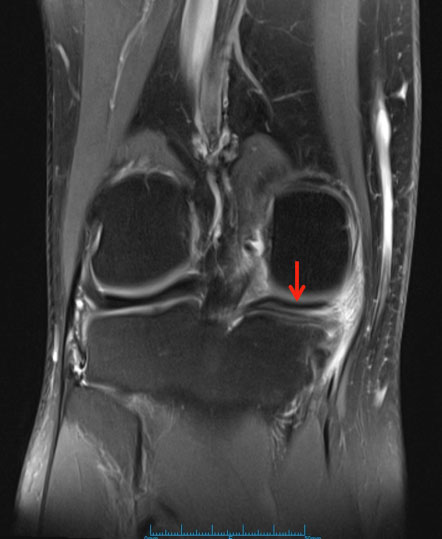
It is well recognized that only about 10% meniscal tears are repairable. Thus, all efforts should be made to try to repair a medial meniscus tear of the posterior horn to prevent the further development of osteoarthritis. If a posterior horn meniscus tear cannot be repaired, it is recommended that patients be followed up closely for any signs of pain or swelling with activities. These are the signs of arthritis and one should be evaluated carefully after a partial meniscectomy to assess for the progression of arthritis whereby further treatment, such as activity modification, physical therapy, injections or a meniscal transplantation, may be performed prior to advanced wear of the cartilage on the medial aspect of the knee.
CLICK IMAGE TO ENLARGE
Post-Op
The treatment for patients who undergo a partial medial meniscectomy is to initiate physical therapy on the first day after surgery. A treatment regimen working on reactivation of the quadriceps muscles, regaining of full knee and patellar mobility, and a quick resolution of knee swelling is emphasized.
In general, we recommend that patients who have a minimal amount of meniscus trimmed out hold back on any impact activities until a minimum of 6 weeks after surgery. In patients who have a significant amount of meniscus resected, it is often recommended to avoid significant impact activities due to the higher risk of the development of osteoarthritis in these patients with this activity.
For patients who have an isolated medial meniscal repair (as in not with a concurrent ACL reconstruction), patients are kept non-weightbearing for 6 weeks. Motion is limited to 90 degrees of knee flexion for the first two weeks after surgery, after which full knee motion is allowed. The use of a stationary bike may be initiated at 6 weeks after surgery and patients are allowed to perform leg presses at ¼ body weight to a maximum of 70 degrees of knee flexion. Impact activities, deep squats, squatting and lifting, and sitting cross legged are limited for the first 4 months postoperatively to maximize healing of the meniscal repair.
Related Studies
- Anatomic Analysis of the Posterior Root Attachments of the Menisci
- Posterior Root Avulsion Fracture of the Medial Meniscus
- Not Your Father’s (or Mother’s) Meniscus Surgery
- Anterior Intermeniscal Ligament of the Knee – An Anatomical Study
- Popliteomeniscal Fascial Tears Causing Symptomatic Lateral Compartment Knee Pain
- Prospective Outcomes Study of Meniscal Allograft Transplantation
Posterior Horn of the Medial Meniscus Injury FAQ
The medial meniscus is the cushion that is located on the inside part of the knee. It is generally divided into 3 separate portions, the anterior horn, the mid-body and the posterior horn. The posterior horn is the thickest and most important for overall function of the knee.
1. What is the posterior horn of the medial meniscus?
The posterior horn of the medial meniscus is the posterior third of the medial meniscus. It is located in the back of the knee. It is the thickest portion and absorbs the most force, so therefore it provides the most stability to the knee and is the most important portion of the medial meniscus.
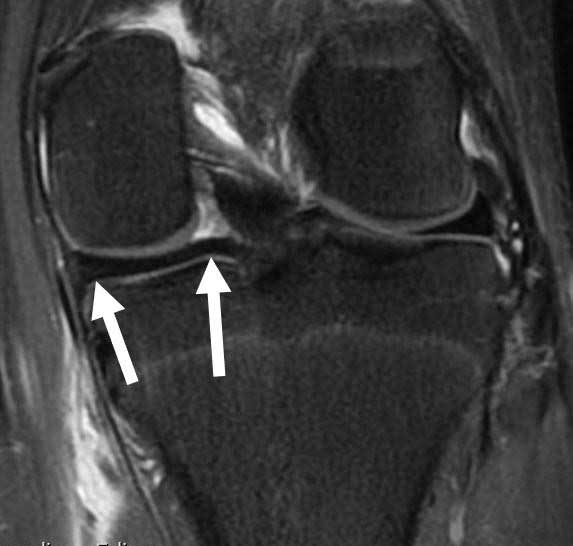
Coronal view MRI scan of a normal posterior horn of the medial meniscus. The meniscus substance is dark throughout, indicating there is no tear within it. In particular, the medial meniscus root attachment to bone is intact.
CLICK IMAGE TO ENLARGE
2. What are causes of posterior horn medial meniscus tears?
There are multiple different injuries that can cause tears of the posterior horn of the medial meniscus. One of the most common causes is when one tears their ACL, the knee continues to slide forward and secondarily tears the posterior horn of the medial meniscus. Deep knee flexion also places significant stress on the posterior horn of the meniscus and can result in a posterior horn meniscus radial tear, peripheral tear, or root tear. In addition, because the medial meniscus does have significant stress at the posterior horn, as one ages, degenerative tears of the posterior horn of the medial meniscus can occur due to these wear and tear changes.
3. What is the dorsal horn of the medial meniscus?
The dorsal horn can also be called the posterior horn of the medial meniscus. It is the posterior third of the meniscus, which is the thickest and provides the most stability and shock-absorbing capacity of the medial meniscus.
4. What is a bucket-handle tear of the posterior horn of the medial meniscus?
A bucket-handle tear occurs when the meniscus tears or separates away from the joint lining and flips like a bucket handle and becomes stuck in the front of the knee. These tears commonly cause a lot of pain and can prevent one from straightening their knee.
5. What does increased MRI signal within the posterior horn of the medial meniscus mean?
Increased MRI signal within the posterior horn of the medial meniscus may mean that there is some intrasubstance degeneration of the medial meniscus. Commonly, at the time of arthroscopy, we can probe the meniscus in these areas and not find meniscus tears. Thus, we feel the majority of these do not cause any symptoms until the meniscus completely tears to the surface and causes more symptoms. These intrasubstance signals can also be called grade 1 or grade 2 MRI changes.
6. What is a horizontal tear of the posterior horn of the medial meniscus?
A horizontal tear of the meniscus happens when there is a split between the upper and lower parts of the meniscus. Sometimes these can be quite large, while other times they can involve smaller portions in the meniscus. In older patients, commonly the lower portion of the meniscus horizontal tear can have other tearing within which makes it not repairable. Therefore, trimming this portion and smoothing it off often will alleviate the symptoms. In younger patients, due to the important shock-absorbing capacity of the medial meniscus, we would recommend a repair of most horizontal cleavage tears. This would involve cleaning out the tear with a shaver to try to stimulate healing and then sewing the top and bottom of the tears together. Most commonly, we will also insert a fibrin clot within the 2 leafs of the tear to try to provide the best biologic healing environment.
7. What type of repairs can be performed with posterior horn medial meniscus tears?
The type of meniscus repair that needs to be performed depends upon the vascularity of the tear and its location primarily. In addition, the size of the tear can dictate the type of repair that should be performed. Smaller tears may be able to be performed with some of the all-inside suture devices, whereas larger tears that require more sutures may not be amenable to these all-inside devices because they can place big holes in the meniscus and be a location for a future tear through this all-inside repair device hole. Therefore, the gold standard inside-out technique may be more indicated. More complex tears may need different suture patterns than the standard vertical mattress repair technique and should be considered in younger patients whereby preserving the meniscus would be a strong goal.
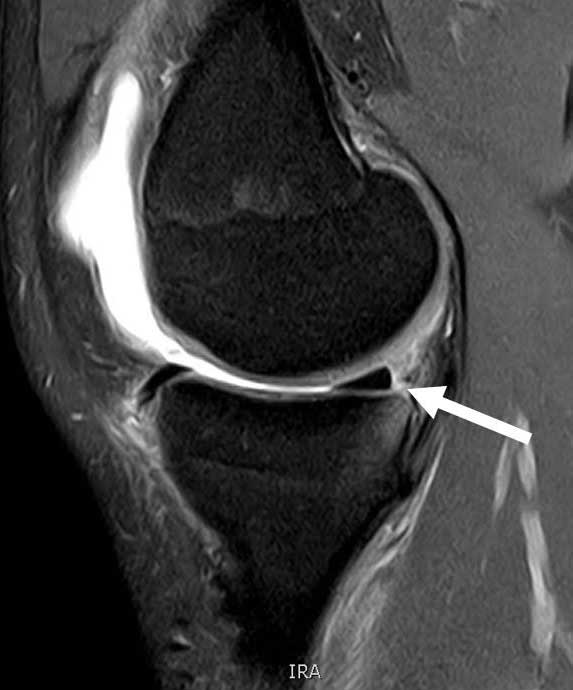
A sagittal viewMRI scan demonstrating a meniscocapsular injury of the posterior horn of the medial meniscus. In particular, this is called a ramp tear. Ramp tears most commonly occur with an ACL tear. If they are not concurrently fixed with an ACL tear, it can lead to stretching out and failure of the ACL reconstruction graft.
CLICK IMAGE TO ENLARGE
8. What is a ramp tear of the posterior horn of the medial meniscus?
A ramp tear is a tear of the meniscocapsular portion of the posterior horn of the medial meniscus. It can be either the part that attaches to the tibia or it can be the entire capsule, with some studies also reporting that red-red zone tears close to the edge of the capsule may also be qualified as a ramp lesion. These are usually defined as occurring with an ACL tear. With ACL tears, the tibia slips forward on the femur. The next structure takes the most stress after an ACL is torn is the posterior horn of the medial meniscus. Therefore, ramp lesions are fairly common at anywhere from 15% to 25% of ACL tears. Repairing a ramp lesion has been found to be very important because failure to repair it can result in the ACL reconstruction graft being overloaded and stretched out or failing.
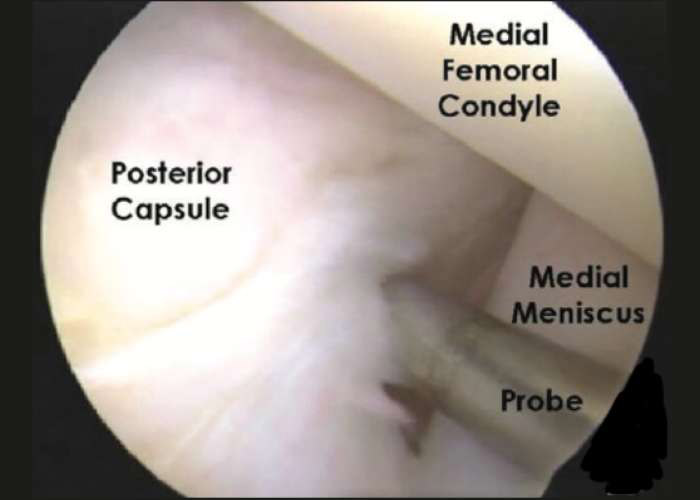
Arthroscopic photography of a left knee medial meniscal ramp tear when viewed posteromedially with the probe demonstrating the separation of the posteromedial capsule away from the posterior horn of thee medial meniscus.
CLICK IMAGE TO ENLARGE
9. What is a meniscocapsular separation of the posterior horn of the medial meniscus?
A meniscocapsular separation occurs when the meniscus tears away from the joint lining. These have the best blood supply. Smaller tears that are stable on probing have a good chance of healing, whereas those that are unstable, especially in the face of an ACL tear, should be repaired.
10. Where does one have pain with a posterior horn medial meniscus tear?
Most patients who have pain with a posterior horn medial meniscus tear will have pain along the joint line and along the back part of their knee and will also have pain when they squat down in the back part of their knee. It is important to differentiate between pain in the front and the back part of the knee. Pain in the front of the knee may indicate swelling or kneecap-related problems, whereas pain in the back of the knee is most commonly associated with a meniscus tear or a Baker’s cyst.
11. When should PRP be used for a posterior horn medial meniscus tear?
It does not appear that any of the biologic treatments that are currently available will result in a larger or complex meniscus tear to heal. Therefore, the main time to use PRP with a posterior horn medial meniscus tear would be at the time of surgery. After suturing, injection of PRP in the joint may potentially provide further biologic augmentation to increase the chances of the tear healing.
12. What is a posterior horn root tear of the medial meniscus?
The posterior horn of the medial meniscus attaches to bone close to the center of the knee and just above the PCL. This attachment site is called the root. Tears of the root can cause the meniscus to slip out of the joint, also called extrusion, which can significantly overload the cartilage. It has been reported that a medial meniscus root tear is equivalent to having the whole meniscus taken out, so having a medial meniscus root tear diagnosed quickly and treated soon is imperative to prevent the development of arthritis. If one already has significant arthritis, then it may not be worth having a repair and a program of rehabilitation may be indicated.
13. What is truncation of the posterior horn of the medial meniscus?
Truncation of the posterior horn of the medial meniscus means that there is a portion that is absent. This most commonly occurs in people who have had a previous surgery and have had the meniscus resected. It may also occur from a large flap that tears away from the posterior horn and either is in the back of the knee or is stuck in the joint line gutter.
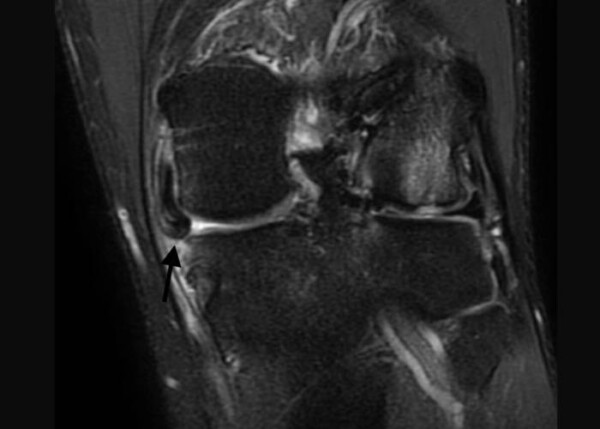
Image of a radial flipped tear of the medial meniscus into the medial gutter in a left knee.
14. What is the treatment for a medial meniscus bucket-handle tear?
In the majority of patients, the treatment for a medial meniscus bucket-handle tear would be to reduce it in place and sew it in place. Only patients who are inactive or who have significant arthritis should have the meniscus resected. The consequences of having a large bucket-handle tear of the medial meniscus are severe, with most patients developing arthritis, so a discussion should be had with your surgeon about attempting a repair if at all possible rather than taking a bucket-handle tear out.
15. What does blunting of the posterior horn of the medial meniscus mean?
Blunting of the medial meniscus usually means that instead of having a triangle-shaped point of the meniscus present that this portion of the meniscus is rounded out. This most commonly occurs in patients who have had a previous meniscus trimming. It can also occur in patients that have had a tear that has flipped out of place and the meniscus has become blunted where the tear tore away from that portion of the meniscus.
